Parking Lot Inspection with Drones: Faster, Safer, and More Accurate
Every construction company has a story about a project that looked simple at first — until the first layer of asphalt came off. What began as a straightforward resurfacing job turned into a string of unexpected costs: soft base layers, missed drainage issues, and unseen cracking that spread further than anyone thought. These surprises are part of the business, but they always carry the same lesson: the better you understand a pavement before you start, the better the outcome.
For years, the only reliable way to assess a parking lot’s condition was to send engineers or inspectors on foot. They would walk the site, measure cracks with rulers, take photos, and assign condition scores section by section. It worked, but it was slow, labor-intensive, and subjective. Two inspectors might give the same lot very different ratings. For small jobs that was tolerable, but for large companies managing dozens of parking lots, the process simply didn’t scale.
In the past few years, a quiet transformation has begun. Drone-based pavement inspection, combined with artificial intelligence, is reshaping how resurfacing and maintenance projects are planned. What used to take days of site work and data entry now happens in hours, and with far greater consistency.
The old problem: time, subjectivity, and safety
Manual pavement inspection has always been demanding work. Teams have to walk active parking lots, often surrounded by moving vehicles. They carry cameras, notebooks, and measuring tools, trying to record the position and width of cracks under the sun or in light rain. When they return to the office, they spend more hours sorting photos and building reports.
For companies bidding on multiple resurfacing projects, this bottleneck limits how many sites they can evaluate each week. It also limits accuracy — human eyes get tired, lighting changes, and it’s easy to miss subtle signs of distress.
The result is uncertainty. Bids are built on averages, not evidence. Contractors add buffers to protect against surprises, while clients often feel they’re paying for work that might not be necessary. Everyone accepts this as normal, but it doesn’t have to be.
The new approach: seeing from above
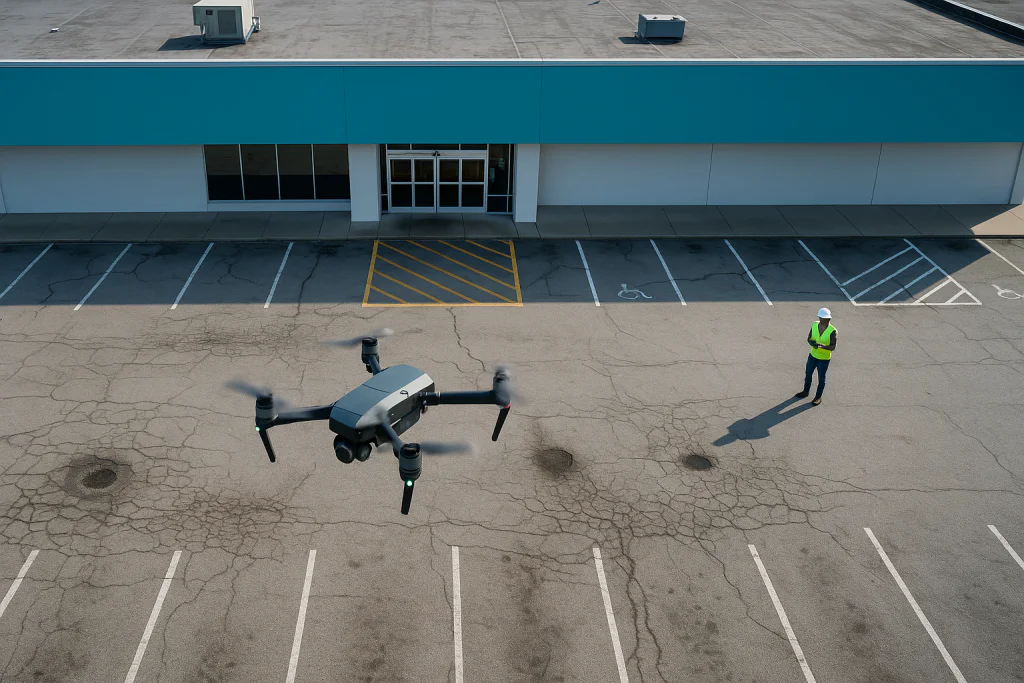
Drone inspections solve several of these issues at once. A trained operator can map an entire parking lot in one automated flight lasting 10 to 15 minutes. The drone follows a grid pattern, capturing high-resolution images with precise GPS data. Depending on the project, the imagery might be captured at 5 millimeters per pixel (0.2 inches) for full PCI-grade analysis or at 10 millimeters (0.4 inches) for general crack mapping and distress quantification.
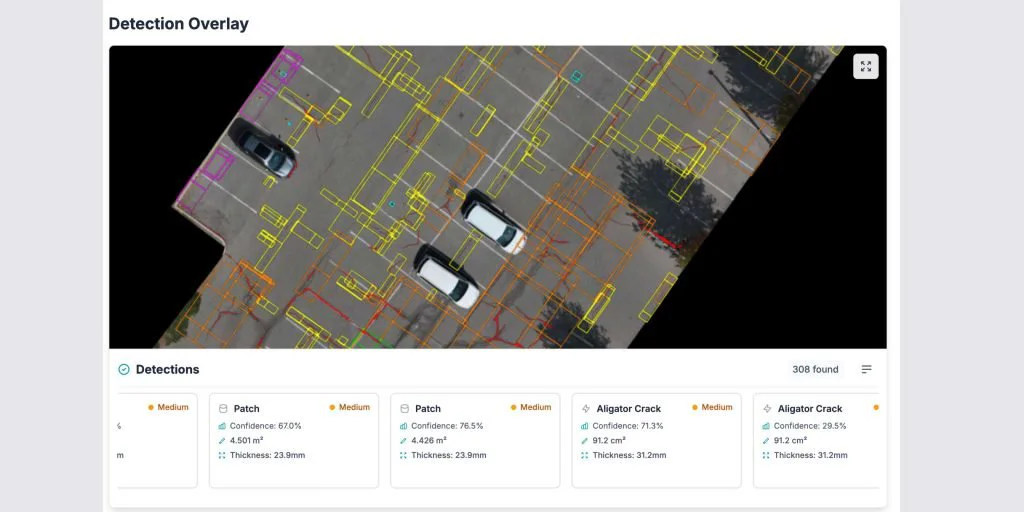
Once the images are captured, the real magic begins. Platforms like HALO AI process the data automatically, stitching hundreds of photos into a single orthomosaic map — a true-to-scale top-down image of the entire pavement. The AI then scans the surface for cracks, patches, raveling, rutting, and other visible distresses. Each issue is classified by type and severity, and its exact location is recorded.
Within about three hours, what started as raw imagery turns into a detailed digital pavement report. Engineers can view every defect, zoom into areas of concern, and export data for maintenance planning or client presentations.
Why it matters: evidence replaces opinion
For contractors, the difference is night and day. Instead of relying on field notes and subjective ratings, they have objective, measurable data. When quoting a resurfacing or repair project, they can show clients exactly what was found and how quantities were calculated. This transparency builds trust and eliminates much of the friction that usually happens during pricing discussions.
Clients — whether property managers, retail owners, or logistics operators — appreciate the clarity. They no longer have to take a contractor’s word for what’s wrong with the pavement. They can see it for themselves, marked clearly on a high-resolution map.
This level of visibility also changes how decisions are made. Instead of treating maintenance as reactive (“we’ll fix it when it fails”), asset managers can plan ahead, comparing lots across their portfolio and prioritizing the ones that truly need attention. Contractors benefit, too, because projects are better defined before work begins — fewer surprises, fewer change orders, and more predictable margins.
Scaling inspections across portfolios
One of the biggest challenges for large construction firms is consistency. When you manage resurfacing across twenty or thirty properties, maintaining uniform inspection standards is almost impossible with manual methods. Drone and AI workflows like HALO AI make it possible.
Each inspection follows the same flight plan and processing parameters, producing data in a consistent format. Whether a parking lot is in Chicago or Dallas, the output looks the same — same color scale, same severity categories, same measurement units. This uniformity allows regional managers to compare conditions objectively and forecast budgets more accurately.
It also enables faster turnaround. With minimal on-site time and automated processing, a company can inspect ten lots in a day and have reports for all of them the next morning. That speed translates directly into opportunity — faster bids, more projects, and more efficient scheduling of crews and materials.
Safety and environmental benefits
Speed and accuracy aren’t the only benefits. Drone inspections also improve safety by keeping personnel out of active traffic zones. Inspectors no longer need to walk live lots or climb over obstacles to photograph distress areas. One pilot, standing safely at the edge of the site, can complete the entire survey without entering hazardous areas.
There’s an environmental side as well. By optimizing resurfacing schedules based on actual condition data, companies can reduce unnecessary milling and paving. Targeted maintenance extends pavement life and lowers the carbon footprint of materials production and transport.
HALO AI in the workflow
What sets HALO AI apart is its ability to fit naturally into existing construction workflows. The platform doesn’t replace engineers — it enhances their insight. After the AI identifies and measures distresses, engineers can review and adjust classifications if needed, ensuring that the data remains accurate and defensible.
HALO AI also stores historical records, allowing teams to compare conditions over time. For clients under long-term maintenance contracts, this means progress can be documented objectively year after year. The system becomes a living archive of the pavement’s performance — proof of work delivered and value preserved.
The broader impact: redefining professionalism
Technology rarely changes an industry overnight. It starts quietly, as a time-saver, then becomes something larger — a marker of professionalism. Drone and AI inspection is following that path in pavement management. Within a few years, it’s likely that clients will expect data-driven reports with every proposal, just as they now expect digital drawings or cost breakdowns.
For forward-thinking contractors, adopting these tools now is not about being flashy. It’s about staying relevant. The firms that embrace data-driven inspection gain a measurable edge: faster quoting, fewer disputes, higher client confidence, and better control of risk.
At its core, this technology returns the industry to something simple — understanding the surface before touching it. With HALO AI and drone-based inspection, every crack tells a story, every surface is documented, and every decision is grounded in fact.
For construction companies, that means fewer surprises. For clients, it means confidence. And for the pavement itself, it means a longer, better-managed life.