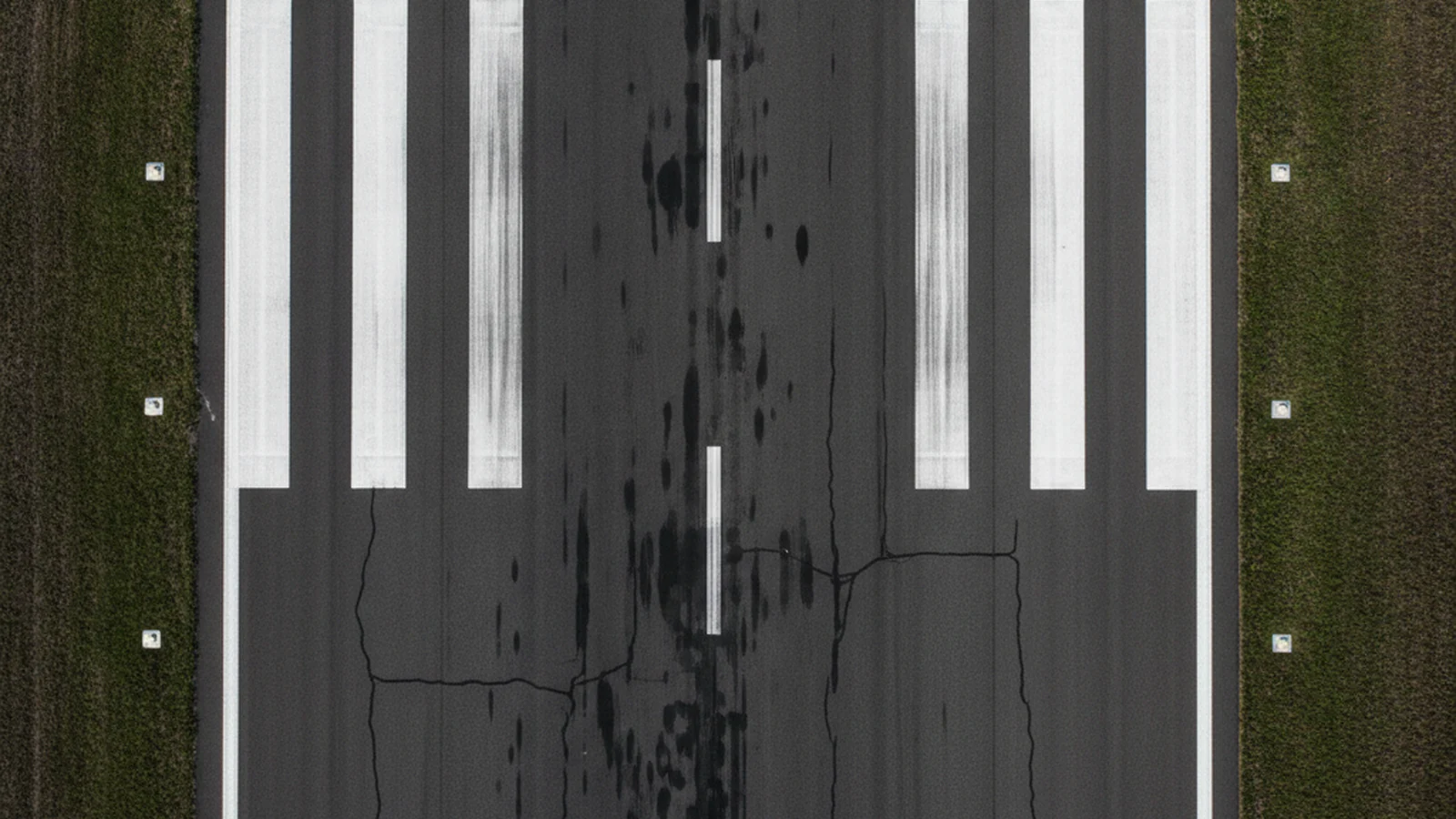
Runways & taxiways
The runway reopens in under an hour. The D5340 report lands the next day.
One off-peak flight, no crews on the surface, and an ASTM D5340 PCI with documentation built to align with FAA Part 139, ICAO Annex 14, and EASA ADR.
Updated: August 2026
The platform, live
A real airfield, scored.
This is airfield pavement in HALO AI, not a screenshot of one. Every colour on the surface is a scored section, and every distress under it was measured off the imagery.

The review happens on a tablet at the apron edge.
For airport operations & pavement engineers
The movement area stays available.
An airport pavement management program sits between two hard constraints: the movement area cannot be closed during operations, and a compliant record has to exist when an auditor asks. FAA AC 150/5380-7B sets the cycle for federally obligated airports at a detailed pavement inspection every year, or every three years where an ASTM D5340 PCI survey is performed. D5340 PCI is what comes back from this flight.
Industry guides put a manual airfield PCI survey at 200+ inspector-hours. In our published comparison a 3,000 m runway takes a drone crew of two about 40 minutes, against roughly 4 hours and five staff on foot.
- An audit trail per finding: dated, measured, on exact coordinates.
- A PCI that holds still, so a change in the score is a change in the pavement.
- Outputs that feed the systems you already run.
How a survey runs
Planned around your movements.
NOTAM & coordination
Planned with ops and ATC, notices filed, capture window agreed to the minute.
Off-peak capture window
A short flight in a low-traffic slot. Every square meter digitized in under 60 minutes, then the surface is released on the schedule you agreed.
Data off the airfield
Imagery moves to HALO AI on our secure cloud, or into a private deployment if that is your requirement.
Report in 24h
D5340 PCI, defect map, and digital twin, before the next night's window.
Shipped capabilities
What HALO AI reads on the movement area.
Every finding carries what the D5340 math takes as input: type, severity, dimensions, and a coordinate.
| Distress | What the report gives you |
|---|---|
| Cracking by type | Longitudinal, transverse, and block cracking detected from 1 mm, with length, width, and area measured to 98% accuracy. |
| Joint condition | Concrete joint spalling, sealant loss, and faulting flagged and rated. |
| Rutting & raveling | Deformation and aggregate loss mapped by extent and severity. |
| Spalling on rigid pavement | Surface and edge spalling quantified slab by slab. |
| Foreign object debris (FOD) | Objects down to 5 mm, from the same flight. See runway FOD detection → |
| Change vs previous inspection | New and worsening defects tracked survey to survey. |
From imagery to intelligence
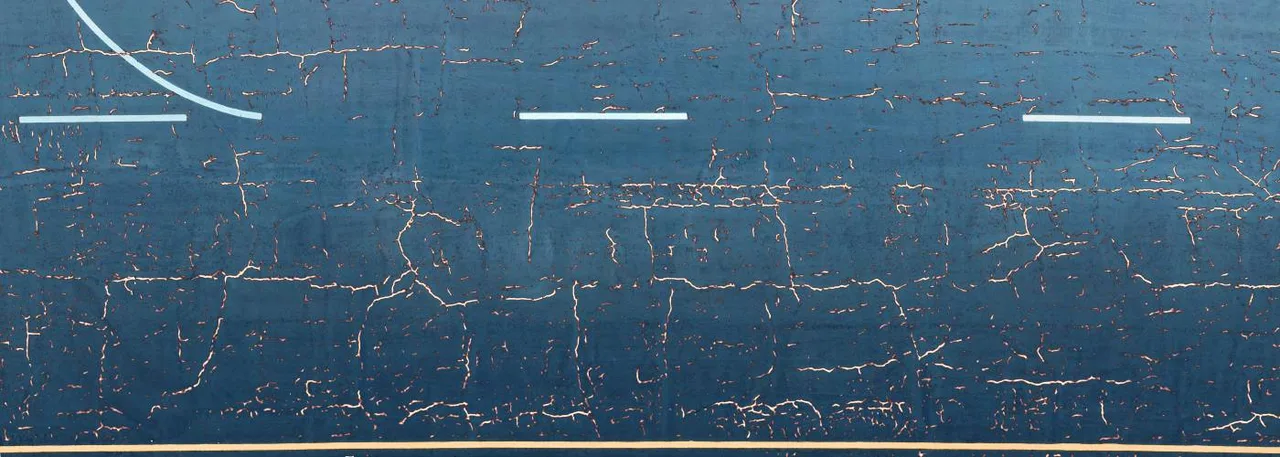
The same runway strip, before and after.

 Raw imagery
HALO AI detection
Raw imagery
HALO AI detection
Drag the handle. Raw capture on one side, HALO AI's crack tracing on the other.
Also available
Markings and rubber, from the same capture window.
Both come out of the flight you are already paying for. Add either one to your next survey through the Early Access program.
Runway and taxiway marking inspection
Paint condition and visibility rated across centerlines, hold-short lines, and designators, so the repainting program is budgeted from measured condition.
Rubber deposit mapping
Touchdown-zone contamination measured survey to survey, so removal cycles run on extent instead of the calendar.
The resolution an airfield needs.
Airfield PCI runs at around 3 mm/px, finer than a road survey, because a D5340 severity call on a joint or a spall depends on it. Any survey-grade drone can fly it at the right altitude. Send us a sample and we'll confirm within 24 hours whether yours qualifies.
Standards & compliance
Every requirement you are audited against, mapped to a deliverable.
One flight, one dataset, evidence for all four frameworks.
| Standard / requirement | HALO AI deliverable that satisfies it |
|---|---|
| ASTM D5340 (airfield pavement condition index surveys) | The survey itself: PCI per feature and sample unit, from a distress inventory covering 100% of the surface. |
| FAA 14 CFR Part 139 (airport certification, self-inspection of paved areas) | A dated inspection record of the paved movement areas, with imagery, location, and measurements on every finding, ready to file and produce in an audit. |
| FAA AC 150/5380-6 (pavement maintenance management program) | D5340 PCI by feature with the inventory behind it, which is the maintenance and rehabilitation planning basis the circular expects you to show. |
| FAA AC 150/5380-7B (airport pavement management program) | The D5340 PCI survey and the distress inventory behind it, which is the condition data an airport pavement management program is built on, and which the circular ties to a three-year detailed inspection cycle rather than an annual one. |
| ICAO Annex 14 (aerodrome pavement surface condition monitoring) | A georeferenced condition map of runways, taxiways, and aprons, repeatable survey to survey, so a trend is measured rather than estimated. |
| EASA CS-ADR-DSN and aerodrome operations requirements (surface condition evidence) | Surface-condition documentation with change tracking between inspections, plus GIS exports into the pavement management system you already run. |
Each arrives as a file: the PDF for the audit folder, the annotated map for the maintenance crew, the quantities table for the tender, GIS exports for your pavement management system, and a navigable twin for everyone who was not airside. See a real scored survey and judge the format first.
These references describe requirements the deliverables are designed to support, not a claim of certification or accreditation.
FAQ
Runway inspection questions.
No closure beyond the capture window, coordinated with ops and ATC and filed in a NOTAM like any other airside activity. Every square meter is digitized in under 60 minutes, and no crew walks the surface.
FAA AC 150/5380-7B sets the cycle for federally obligated airports: a detailed pavement inspection every year, or every three years where an ASTM D5340 PCI survey is performed. D5340 PCI is what one off-peak flight returns. How that maps onto your own airport pavement management program is a conversation for your compliance team, and we have it before the survey rather than after it.
ASTM D5340, scored by sample unit, branch, and section, with documentation built to support FAA Part 139, FAA AC 150/5380-6, ICAO Annex 14, and EASA CS-ADR. See the standards-to-deliverables table above.
Within 24 hours of the capture window for a single runway, PCI scoring and defect map and twin together. A large or multi-runway airfield carries more surface than that, so we agree its schedule with you before the survey rather than quote a figure that does not fit your field.
Yes. HALO AI runs as a secure cloud platform, and private deployment is available on request for airports and government operators with data-residency requirements.
Yes, from the same flight. FOD detection is our most field-proven capability and runs either inside a condition survey or on its own schedule. See runway FOD detection.
The variables are the extent of the movement area, how many features you want scored, and your resurvey interval. Most airports start with the fixed-price pilot below, or see how pricing works.
Recommended start
The Pilot Inspection Program.
One runway, one off-peak window, at a fixed price agreed before capture. The full terms are on the pricing page.
Fly Tuesday night. File the D5340 report Wednesday.
Debris is the other thing on your runway, and the same flight finds it. See runway FOD detection, or start with a sample report.