2026: Revolution in Photogrammetry Cameras
For years, photogrammetry has been limited by one invisible bottleneck: sensor readout. Lenses improved, drones got faster, and processing became cheaper, but the camera itself was still fighting physics. In 2026, that changes. Sony is pushing a new generation of ultra high resolution sensors built around something the mapping world has wanted for a long time: global shutter at serious megapixels.
This is not a small upgrade. It is the beginning of a new camera class designed for high speed capture, distortion free imaging, and extremely accurate reconstruction from the air.
Sony’s new high resolution global shutter wave is not a rumor anymore
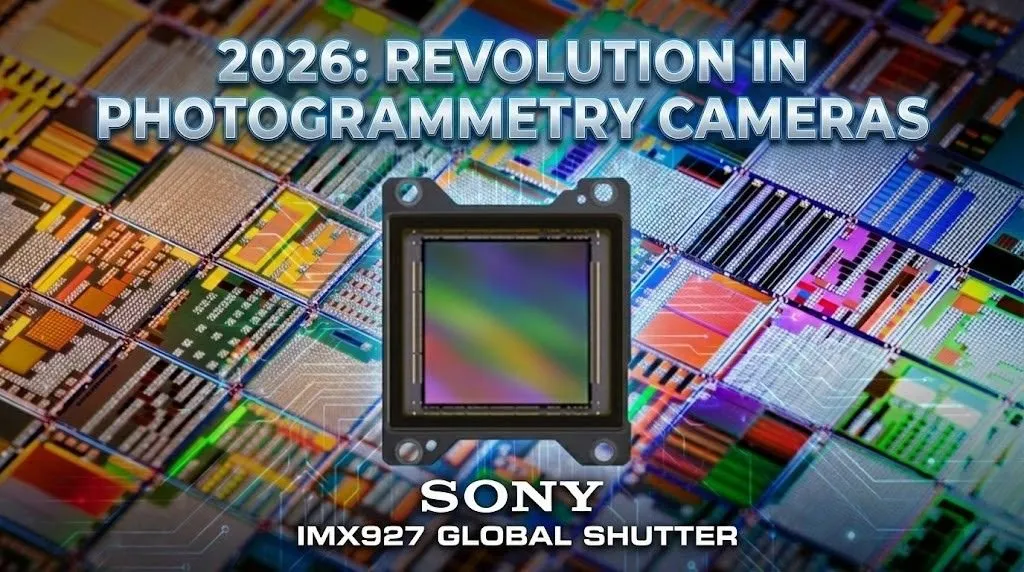
Sony Semiconductor has been expanding its Pregius S global shutter lineup, and it is now reaching resolutions and speeds that were considered unrealistic for real world mapping just a few years ago. The headline sensor is the Sony IMX927, an industrial global shutter sensor with 105.51 megapixels and output up to 100 fps.
This is joined by two other new sensors, IMX928 and IMX929, aiming at different points on the speed versus resolution tradeoff. Public reporting around these sensors points to performance levels like 68MP at high speed, and up to 225 fps at 50MP, all with global shutter.
Sony has also been publicly pushing stacked global shutter designs aimed at high throughput, such as the IMX925 family, announced as a high speed industrial sensor with 24.55MP and up to 394 fps.
Even if you do not plan to buy an industrial machine vision camera, this matters because industrial sensor roadmaps often define what becomes possible for high end aerial cameras later.
Why global shutter is such a big deal for photogrammetry
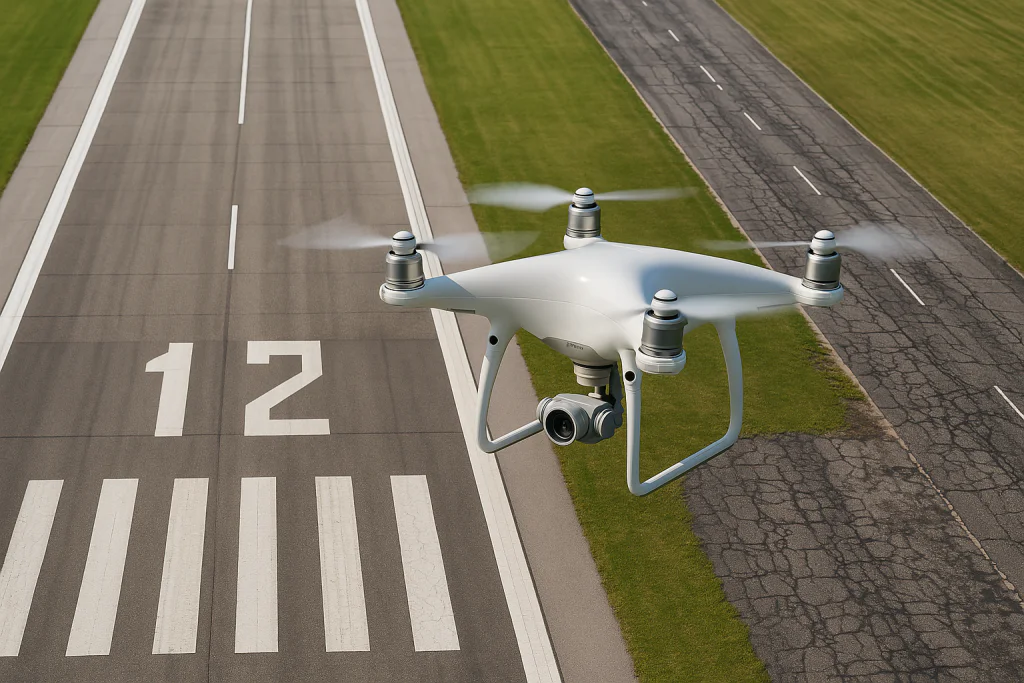
Most mapping cameras today still rely on a rolling shutter. That means the sensor exposes the image line by line, not all at once. If the drone is moving, you get geometric distortion that can look subtle in a single photo but becomes brutal at scale. Pavement seams bend, runway markings shift, cracks “slide” across frames, and every small distortion adds up when you stitch thousands of images together.
Global shutter fixes this at the source. Every pixel is captured at the same moment, which means:
Your orthomosaic becomes more accurate even at higher speed
Your tie points become cleaner and more stable
Your model alignment gets easier and faster
Your AI outputs become more consistent because texture is not warped between frames
For airports and road inspection, it is even more important. These are flat, high precision surfaces where small distortions are not “hidden” by 3D geometry. When you want measurable cracks, rutting patterns, sealed joints, and accurate segment boundaries, rolling shutter becomes the enemy.
Global shutter is not just a quality improvement. It is a reliability improvement.
The specs that matter, and why they change workflows
The most exciting part is not just the megapixels. It is the combination of resolution and speed with distortion free capture.
A sensor like IMX927 at 105MP and up to 100 fps suggests a future where you can fly faster, cover more ground, and still keep sharp reconstruction quality.
It also shifts what “optimal settings” look like in real missions:
You can push higher airspeed without worrying that the geometry will collapse
You can shorten the capture window, which matters for operational airports
You can reduce the amount of oversampling required just to compensate for motion distortion
You can design higher productivity flight plans without sacrificing accuracy
There is another hidden advantage. Global shutter strongly supports multi camera systems because synchronization becomes easier and the output is more geometrically consistent between viewpoints. That matters for advanced pipelines, including 3D change detection and surface analytics.
When will this reach cameras you can actually buy?
Right now, the newest Sony sensors are positioned as industrial imaging parts, which typically means they appear first in machine vision cameras, not in a handheld or drone integrated mapping camera.
The real market path usually looks like this:
First: sensor announcement and early evaluation boards
Then: industrial camera manufacturers ship the first products
Then: early adopters in infrastructure and inspection integrate them
Finally: mature mapping payloads and camera modules appear
A realistic expectation is 12 to 24 months from a major sensor announcement to widely available, field tested, mapping optimized products you can buy “off the shelf” in volume. In other words, the 2026 timeline is very real, but it will likely arrive in stages, not all at once.
Sony has already proven global shutter can move beyond industrial. Their A9 III became a milestone for consumer global shutter cameras, and that was not an accident.
The direction is clear: this technology is trickling down.
The photogrammetry world is about to get faster, cleaner, and more precise
If you are running large surveys, the next generation of sensors will not just make images prettier. It will directly impact cost per kilometer, cost per runway, and cost per square meter.
Higher speed capture reduces flight time
Distortion free imaging increases reconstruction stability
Better geometry improves measurement confidence
Better input improves AI detection accuracy downstream
In pavement inspection, you feel this immediately. Global shutter reduces false “curvature” artifacts, improves seam line alignment, and stabilizes crack patterns across frames. That alone has huge value for any workflow that aims to produce repeatable PCI scoring and reliable change detection.
A quiet hint about what comes next from Fadron
There is a reason we are watching Sony’s global shutter roadmap so closely.
At Fadron, we believe photogrammetry cameras are entering a new era where global shutter is not a luxury feature. It becomes the baseline for high precision inspection at scale. And yes, we are already exploring how to build a dedicated mapping camera around this new class of sensors, optimized specifically for pavement, airports, and critical infrastructure.
If you want to be among the first to learn what is coming next, follow Fadron and reach out. Some revolutions start quietly, but you can always hear them if you know where to listen.