How to Navigate Privacy Concerns When Using Drones to Survey Large Infrastructure Projects
Deploying drones for aerial surveying tasks makes the exercise more manageable, effective, and less expensive. However, drone use comes with various privacy issues. Thus, you must know how to navigate privacy concerns when using drones to survey large infrastructure projects.
Navigate privacy concerns by complying with privacy laws, utilizing the code of ethics, and ensuring data security. You can also anonymize personal data, limit data collection and retention, and use encryption.
A drone flying over an extensive infrastructure may capture images of nearby residential properties. Thus, the owners may feel that their privacy has been violated when that happens without their consent.
This article outlines various effective tactics for surveying your property using a drone without infringing on other people’s privacy.
5 Tips on How to Navigate Privacy Concerns When Using Drones to Survey Large Infrastructure Projects
Use the following tips to navigate privacy concerns when surveying infrastructure projects:
Comply With Privacy Laws
Without adequate care, cameras and sensor-equipped drones capture data of the survey area and its surroundings. Thus, you’re highly likely to collect data on nearby people, activities, and properties, triggering privacy concerns.
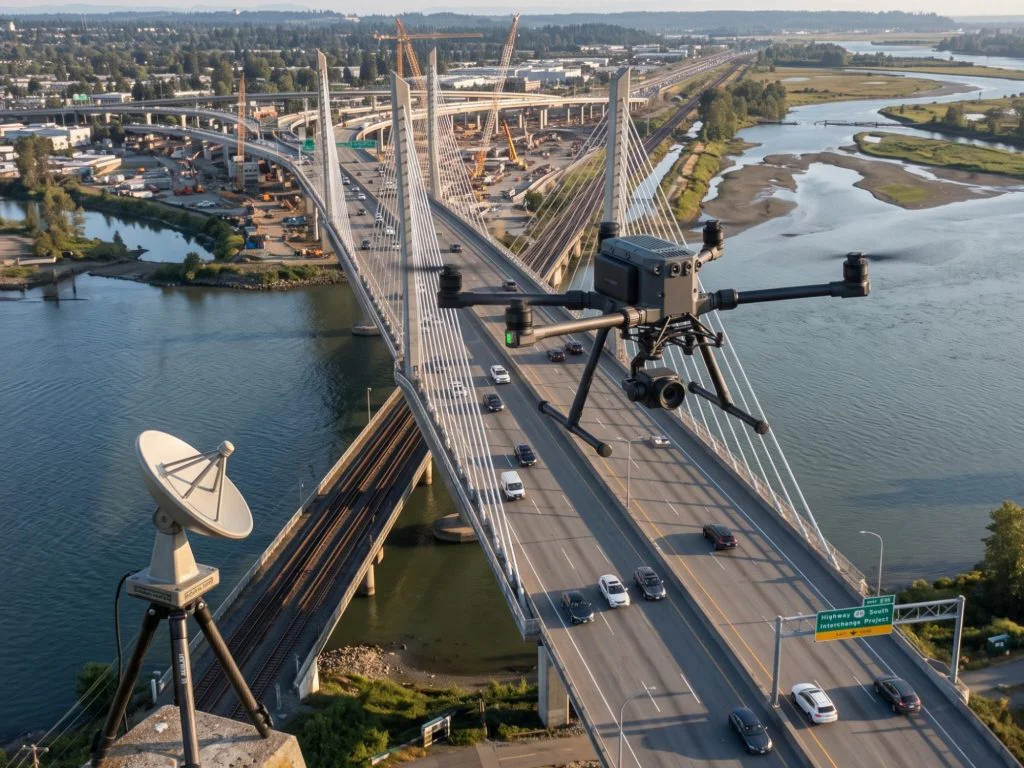
For example, when surveying a construction site using a drone, you may capture its neighborhood, consequently interfering with the residents’ privacy.
Follow privacy guidelines and all drone flying laws in your operation area. For instance, avoid flying your device over private residences without the owner’s consent and limit your data collection to the target infrastructure.
Utilize the Code of Ethics
Collecting data in sensitive areas raises privacy concerns. For that reason, the drone industry has implemented strict operational guidelines to ensure minimal intrusion and respect for privacy.
Thus, it’s essential to determine the privacy policies that guide drone operations in your flying area before your flights.
Implement the data management protocols and ethical use policies to ensure data protection and respect for personal privacy. Always use the data responsibly and ethically.
Ensure Data Security
Execute the following to ensure data security:
- Implement extra software features that limit data collection and retention. For example, you can restrict data collection by turning off collection once the drone leaves its predetermined path. The software also automatically erases all data after downloading to limit data retention.
- Ensure a high level of information and information technology security in your drone’s system.
- Put access control on the drone, stored data, and operational ground control systems.
- Set privacy as your drone’s default setting after unboxing it to make it privacy-protective.
Anonymize Personal Data
Program your drone to automatically detect and remove human images via blurring, hiding, or blanking to anonymize any captured personal data.
Where you capture images for personal use, avoid publishing them on the internet in a manner that makes them accessible to third parties. Ensure that the public can’t identify the captured individuals or private spaces such as residences, terraces, and gardens.
Use Encryption
Secure drone data by transforming it into a code unauthorized parties can’t access. While some drones feature built-in encryption capabilities, others require eternal applications and devices.
There are two primary encryption types, asymmetric and symmetric, and your choice depends on your preferences and needs.
Below are a few ways you can use encryption to address privacy concerns:
- Code stored data with standards like AES-128 and keep the encryption keys away from the encrypted data.
- Regularly update the firmware and software to improve encryption and close security gaps.
- Ensure secure transmission by encrypting data during drone-ground station transmissions.
- Utilize strong encryption keys and algorithms, keeping them updated and safe.
- Restrict key validity in communication volume and time.
Parting Shot
As drones continue to play a fundamental role in surveying, it is essential to know how to navigate privacy concerns when using drones to survey large infrastructure.
Hence, the privacy protection dialogue must continue among all stakeholders (operators, regulators, manufacturers, and the public) to balance this technology’s benefits with people’s privacy.
Thankfully, our article provides five actionable tips to help you ensure ultimate privacy for others during your flights. They include complying with the set privacy laws, utilizing the ethical use policies, encrypting data, anonymizing personal information, and ensuring data security.
Applying these guidelines helps you use the technology for more effective surveying without compromising others’ fundamental privacy rights.
Want to learn the application of drones in construction? Check here.
Want to learn what is the best software for photogrammetry? Check here.
What is the difference between photogrammetry and LiDAR surveying? Check here.