Runway FOD Detection: How Drones Identify What Walk-Down Crews Miss
Every airport maintenance team has a story about a near miss. A piece of safety wire sitting just off the centerline that nobody saw until the third pass. A bolt that turned up cracked on a turbine blade, sending the investigation back to a runway sweep that had been signed off as clear hours earlier. Foreign object debris detection exists for exactly this reason – debris doesn’t announce itself. It sits quietly on the pavement until an engine finds it first.
The old method: thorough, but only as good as the eyes doing the looking
A standard manual FOD sweep takes fifteen to thirty minutes, depending on runway length and crew size. Inspectors scan for anything that doesn’t belong: hardware, pavement fragments, wildlife remains, ice. It’s careful work, but it fights against itself. Flashlights illuminate a narrow cone, and small, dark objects blend into asphalt almost by design. A five-millimeter bolt is nearly invisible from a walking pace at 3 a.m. Fatigue compounds it – the fifth nightly sweep is rarely as sharp as the first. And because every closed minute costs money, there’s constant pressure to move fast, which works against the slow, deliberate scanning that catches the smallest threats.
The new approach: a camera that doesn’t get tired
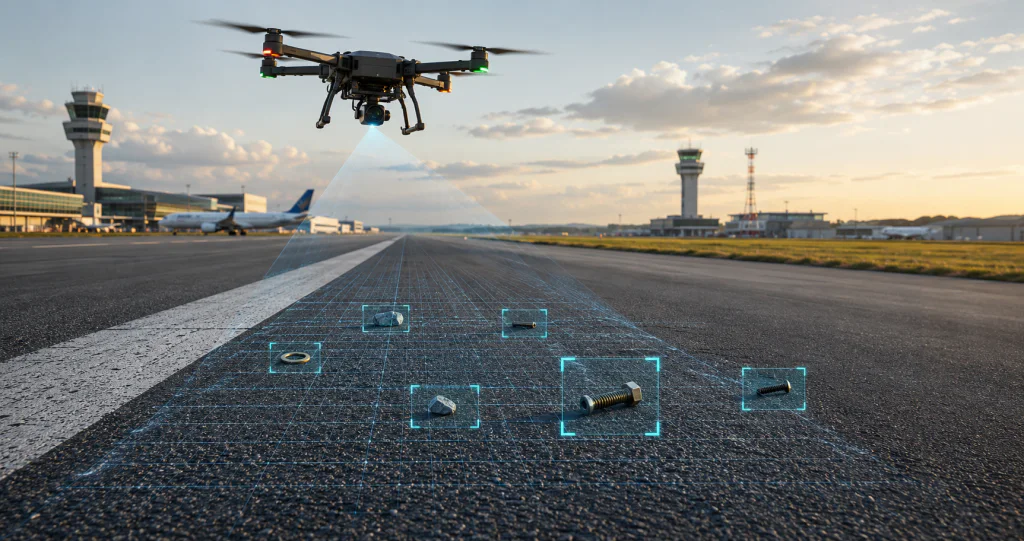
A drone runway inspection flies a low-altitude pass over the surface, capturing high-resolution imagery, sometimes paired with thermal sensors. AI runway inspection models trained to recognize foreign objects scan every frame, flagging anything that breaks the pattern of clean pavement.
What used to take a crew twenty or thirty minutes now takes a UAV runway inspection three to eight minutes. The detection threshold doesn’t shift from shift to shift — the same model that catches a coin-sized fragment on the first flight catches it the same way on the last. Objects as small as five millimeters, well below what a walking inspector reliably spots, show up clearly and get tagged with exact location data. It also leaves a record: a time-stamped, geolocated image of the entire surface, instead of a verbal “runway clear.”
The camera matters as much as the drone
A FOD detection system is only as good as its sensor. As covered in our breakdown of the best photogrammetry cameras for aerial inspection, high-resolution RGB sensors are the workhorse for resolving small objects without blurring them into pavement texture. Thermal cameras add a second layer for night operations, since metal debris often holds a different temperature signature than the asphalt around it. The strongest setups pair a sharp RGB pass during the day with thermal coverage at night.
Why this matters?
The value isn’t just speed – it’s consistency. FOD events are rare by design, but the cost of a single missed object is enormous. An airport FOD detection method that performs the same way every time, regardless of shift or fatigue, closes a gap that’s existed for as long as walk-downs have. It also cuts closure time, which ripples into delayed departures and diverted arrivals. Trimming a twenty-minute closure to under ten, every cycle, adds up over a year.
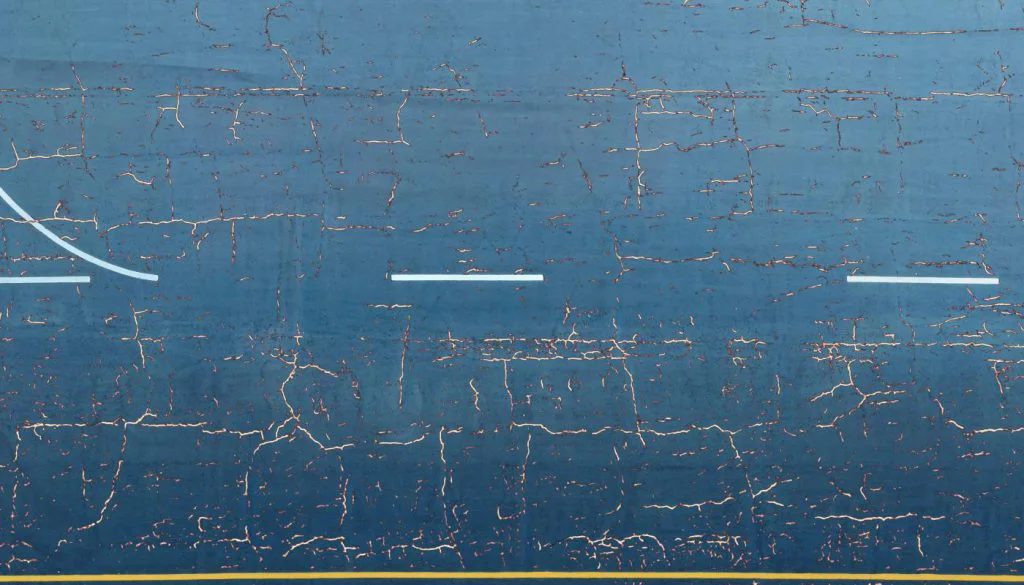
The same drone platforms doing FOD scans often double as airport pavement inspection tools, catching cracking, rutting, and settlement in the same flight. That overlap turns two separate inspection programs into one connected workflow, strengthening both immediate safety and long-term airport infrastructure inspection.
What drones still can’t do
A drone can spot a bolt, but it can’t pick it up. Confirmed FOD still needs a human response, and some checks — a loose light fixture fastener, a pavement crack needing a hands-on look — still call for someone on-site. Weather sets real limits too: heavy rain, fog, or high wind can ground a drone on a day a ground crew can still work, slower and with reduced visibility.
The airports getting the most from this aren’t replacing their FOD programs — they’re restructuring them. Drones handle the frequent, fast, wide-coverage scans; ground crews handle confirmation and retrieval.
Where this is already flying
San Sebastián Airport has been running a drone-and-5G FOD detection system, streaming live imagery for instant AI analysis. Heathrow has trialed drones for runway FOD and surface damage checks, cutting inspection times well below manual rounds. Singapore Changi has deployed AI-powered drone detection to sharpen its routine safety checks. In each case, the goal wasn’t to remove people from the runway — it was to give them better information before they set foot on it.
The walk-down crew isn’t disappearing. But the job is changing – from being the only line of defense against foreign object debris, to being the team that responds once a drone has already told them exactly where to look.