Winning Drone Inspection Contracts: A Practical Guide for UAV Service Providers
Most drone service providers lose public contracts before the evaluation committee ever reads their technical proposal. The loss happens earlier, in the gap between what the agency actually needs and what the provider thinks it needs to demonstrate. Public agencies evaluating drone inspection contracts aren’t looking for the most impressive drone. They’re looking for the lowest operational risk, the most defensible data, and the clearest evidence that the provider has done this before and can do it consistently.
This guide covers what public procurement actually evaluates, where most providers fall short, and what separates the proposals that win from the ones that don’t.
What public agencies are actually buying
The starting point for any winning drone inspection contract proposal is understanding that a public agency isn’t buying flights. It’s buying outcomes and documentation. The distinction matters because it changes everything about how a proposal should be structured.
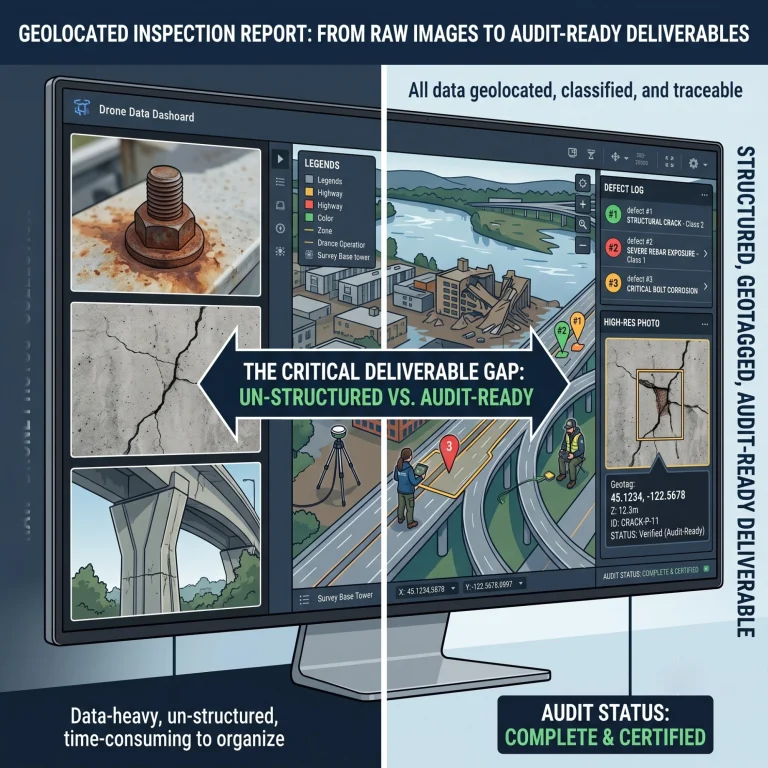
A transport authority commissioning drone inspection of a bridge network needs defensible condition data it can use to justify maintenance budgets, prioritize repairs, and demonstrate regulatory compliance. A utility managing transmission corridors needs consistent, repeatable imagery it can feed into an asset management system. An airport authority needs inspection records that hold up to audit. In every case, the contract deliverable isn’t hours in the air, it’s structured, reliable, usable data with a clear chain of custody.
Providers who pitch hardware capabilities, flight times, and sensor specifications without grounding them in the agency’s specific documentation and compliance needs tend to lose to providers who speak the agency’s language from the first page of the proposal.
Compliance is the first filter, not the final detail
Before an evaluation committee looks at methodology or pricing, it looks at compliance. In the current regulatory environment, this has become more complex and more consequential than it was even two years ago.
For contracts with US federal agencies or federally funded projects, NDAA compliance is now a baseline requirement, not a differentiator. Following the FCC’s December 2025 addition of foreign-produced drones to its Covered List, agencies with government contracts are increasingly mandating platforms from the Blue UAS Cleared List. A proposal that leads with DJI hardware for a federally connected contract is likely to be disqualified before the technical evaluation begins, regardless of how strong the rest of the submission is.
Beyond platform compliance, evaluation committees look for evidence of regulatory standing. Part 107 certification for all pilots on the project, documented waivers for any planned night or over-people operations, and a clear airspace coordination plan for the specific site are baseline expectations. For contracts that involve extended corridor work, agencies are beginning to ask about BVLOS capability and Part 108 readiness, since the FAA’s proposed rulemaking published in August 2025 signals that scalable BVLOS operations are coming, and forward-looking agencies want to know their provider can scale with them.
Data quality and consistency matter more than sensor specs
A common mistake in drone inspection proposals is leading with sensor specifications rather than data quality outcomes. Saying a platform carries a 45-megapixel camera with RTK positioning tells an evaluation committee something about the equipment. Saying the workflow produces georeferenced orthomosaics accurate to 3 cm absolute, validated against check points on every mission, with a defined quality assurance process before delivery, tells them something about the outcome.
Public agencies don’t have the internal expertise to evaluate sensor specifications in isolation. What they can evaluate is whether the deliverables match the format their asset management systems require, whether the accuracy claims are independently verifiable, and whether the provider has a documented process for catching and correcting errors before data leaves their hands. Proposals that address these questions directly, with specific examples from past projects, consistently outperform proposals that lead with technology.
RTK and PPK positioning workflows are increasingly expected rather than optional for infrastructure inspection contracts. The ability to reduce or eliminate ground control points through reliable GNSS correction isn’t just a workflow efficiency argument – it’s a data integrity argument, and agencies evaluating inspection proposals understand that distinction better than they did five years ago.
Past performance is the hardest thing to fake
Public procurement scoring almost always includes a past performance component, and for drone inspection contracts it carries disproportionate weight. Agencies are risk-averse by nature, and an inspection program that produces poor data or misses a significant defect creates liability that procurement officers are evaluated on. A provider with three documented projects of comparable scale and asset type, with verifiable client references, will consistently outscore a technically superior provider with no comparable track record.
The practical implication is that winning large public contracts requires a deliberate track record building strategy, not just capability development. Smaller municipal contracts, subcontracting arrangements on larger programs, and pilot projects with public agencies are not just revenue. They are the past performance documentation that makes the next proposal competitive. Providers who treat every completed project as a reference case, with structured outcome reporting and client feedback, compound their competitive position over time in a way that equipment investment alone cannot replicate.
The proposal structure that works
Public agency evaluation criteria are typically published in the RFP itself, and the most straightforward strategic advice for any drone inspection contract proposal is to organize the submission around the stated evaluation criteria, in the order they appear, with each section directly addressing the specific language the agency used. Evaluation committees score proposals against the criteria they published. A submission that answers a different question than the one asked, however impressively, scores poorly.
Beyond structure, the proposals that perform best in public procurement share a few consistent characteristics. They quantify everything that can be quantified: number of comparable projects completed, accuracy benchmarks achieved, inspection time per asset, turnaround time from flight to deliverable. They include named personnel with specific qualifications rather than generic team descriptions. They address risk explicitly, not by claiming nothing will go wrong, but by demonstrating that the team has a plan for the most likely failure modes: weather delays, airspace conflicts, equipment issues, and data quality problems.
Pricing strategy in public procurement
Public contracts aren’t always awarded to the lowest bidder, but price is almost always a scored evaluation criterion and it requires as much strategic thought as the technical sections. The most common pricing mistake drone service providers make in public tenders is underpricing to win, then discovering that the scope was larger or more complex than the proposal assumed.
Public agency contracts typically have limited mechanisms for cost recovery when actual scope exceeds estimated scope. Winning a contract at a price that makes delivery unprofitable, or that requires cutting corners on quality assurance, creates reputational damage that follows a provider into the next procurement cycle. Pricing that reflects the actual cost of delivering consistent, audit-ready data, with a clear breakdown that the agency can evaluate, positions a provider as a serious operator rather than a low-cost alternative, and that positioning matters across the full evaluation, not just in the price section.
Where the market is heading
The drone inspection contract landscape is shifting in ways that reward providers who invest in data infrastructure as much as flight infrastructure. Utilities running hundreds of inspections per year are building internal teams for routine work and outsourcing the complex, specialized, or high-volume corridor work to external providers. The routine inspection market is commoditizing. The specialized market, which requires BVLOS capability, multi-sensor workflows, AI-powered analytics pipelines, and data deliverables that integrate directly with enterprise asset management systems, is growing and remains dominated by providers with significant technical and operational depth.
For drone service providers targeting public infrastructure contracts in this environment, the competitive question is less about which drone to fly and more about what happens to the data after landing. Agencies that are moving toward digital asset management, predictive maintenance programs, and AI-assisted condition assessment need providers who can deliver structured, analytics-ready data rather than imagery that requires manual review. The providers building those capabilities now are positioning themselves for the contracts that will define the next five years of public infrastructure inspection procurement.