Why Regular Pavement Inspections Save More Than They Cost
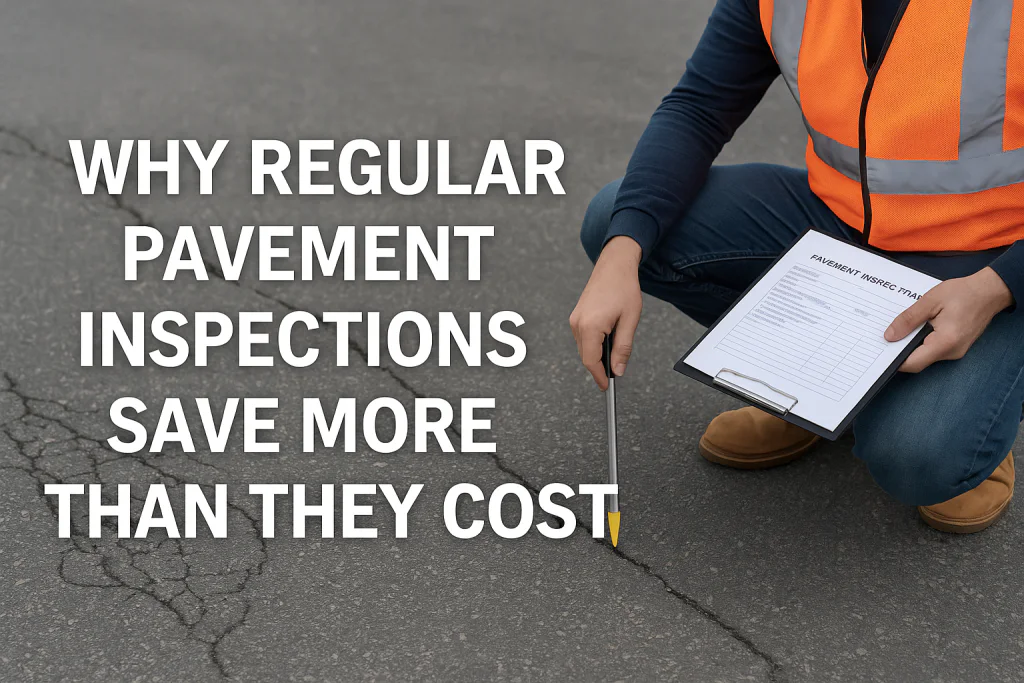
Every engineer knows that asphalt does not fail overnight. It fails quietly, one unnoticed crack at a time. The moment water enters the base layers, the clock starts ticking — and the cost of repair begins to multiply. Yet most pavements are inspected only when the damage becomes obvious enough for a complaint. By then, what could have been sealed for a few hundred dollars now requires resurfacing that costs tens of thousands.
Regular pavement inspections are not about collecting more data. They are about controlling uncertainty. The single most expensive mistake in pavement management is reacting too late. A good maintenance program, informed by frequent inspections, stretches the service life of assets by years and reduces total lifecycle costs by 30 to 50 percent.
What makes inspections so powerful is the ability to detect patterns of deterioration early. Cracks rarely appear randomly. They form clusters, align with traffic flow, and reveal where drainage or load-bearing capacity is failing. When captured regularly — say every six or twelve months — those small signals build a timeline that helps engineers act before the underlying structure breaks down.
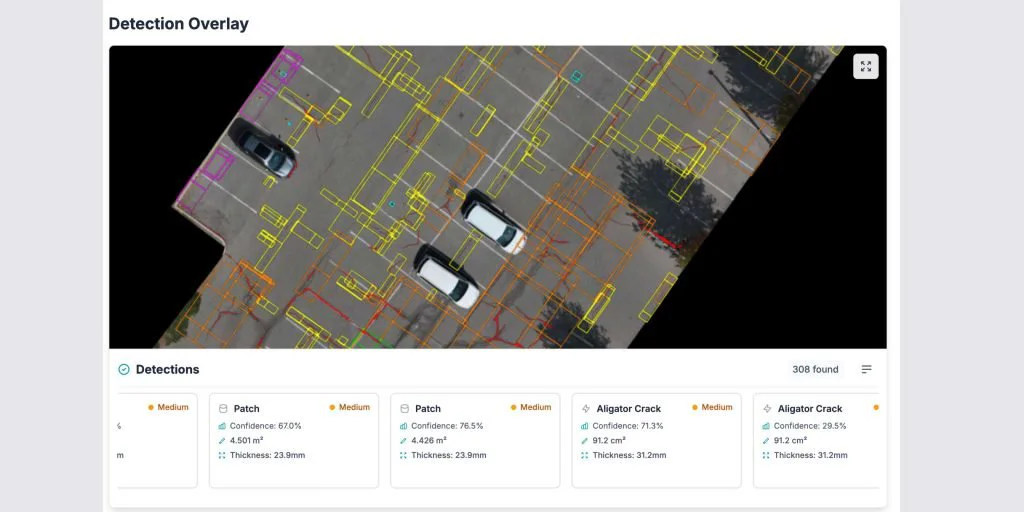
Traditionally, this kind of monitoring was too expensive. Manual fieldwork required crews, road closures, and subjective visual ratings. This is where automation changes the economics. With HALO AI, a complete inspection of a large parking lot or a kilometer of roadway can be done in a 10 to 15-minute automated drone flight. The system processes the images in roughly three hours and produces a full condition map with quantified crack data.
For engineering-grade Pavement Condition Index (PCI) analysis, images are captured at around 5 millimeters per pixel (0.2 inches). For simpler condition monitoring, such as measuring the extent of linear or alligator cracking, 10 millimeters (0.4 inches) is sufficient. The difference is that inspections can now be scheduled routinely — monthly if needed — without the traditional cost burden.
The financial case is straightforward. Suppose a parking lot costs $200,000 to repave. Regular annual inspections with preventive crack sealing might cost $2,000 per year but delay full resurfacing by five to seven years. That deferral alone represents tens of thousands in avoided expense. More importantly, it keeps assets functional, safe, and presentable without sudden budget shocks.
The long-term value, however, goes beyond maintenance savings. Consistent pavement data improves budget forecasting, helps justify funding requests, and strengthens client confidence. Contractors who rely on measurable, AI-based assessments can price jobs more accurately, show transparent evidence of distress, and avoid disputes. Owners, in turn, gain the assurance that decisions are based on facts, not opinions.
Regular pavement inspections are a discipline, not a luxury. When supported by modern tools like HALO AI, they transform how infrastructure is managed — from reacting to failures to anticipating them. In an industry where small cracks become million-dollar problems, early insight is not an added cost. It is the best investment you can make.