Parking Lot Safety Inspection: A Trip Hazard Checklist for Owners
For many commercial properties, the parking lot is the largest walking surface on the site. A CNA study of its claims from 2010 to 2016 found that 33% of slip-and-fall events happened on parking lot surfaces, against 40% on interior walking surfaces and 27% on sidewalks leading to entrances. Retail and real estate had the highest frequency of any sector. The national picture points the same way: the National Safety Council reports that falls made up 35% of preventable nonfatal injuries treated in emergency departments in 2023.
This guide is for property, facility and risk managers, and for the insurers who cover their sites. It is written for the three moments when the condition of a lot suddenly matters: a claim on your desk, a policy renewal, and an acquisition. It covers why the inspection record carries so much weight, which height changes the standards care about, a checklist you can use on any lot, and what a drone survey with HALO AI records.
Why the inspection record matters as much as the repair
In a typical premises liability claim, the person who fell has to show three things: that a dangerous condition existed, that the owner knew or should have known about it, and that the owner failed to fix it or warn about it. That is the plain-language summary from Nolo, and the details vary by state.
The middle element is where parking lots become expensive. "Should have known" is constructive notice, and how long a hazard existed is often the key evidence for it. Maintenance and inspection records are part of that evidence, and regular inspection is part of what reasonable care looks like. An owner who can show when the lot was last inspected, what was found and when it was repaired can answer the question every claim asks. An owner without a record is answering from memory.
The amounts involved explain why insurers watch this closely. CNA has put the average general-liability slip-and-fall claim at about $30,000, and claims involving traumatic brain injury at up to nearly $300,000, as reported by Risk & Insurance in 2018.
The height changes that matter
Most trip hazards in a parking lot are changes in level: a raised slab edge, a settled patch, a pothole rim, a heaved crack. The 2010 ADA Standards for Accessible Design set the clearest public thresholds for them:
- Up to 1/4 in (6.4 mm): a change in level may be vertical (§303.2).
- 1/4 in to 1/2 in (6.4 to 13 mm): the change must be beveled, no steeper than 1:2 (§303.3).
- Over 1/2 in (13 mm): the change must be treated as a ramp (§303.4).
- Surfaces must be stable, firm and slip resistant (§302.1).
- Accessible parking spaces and access aisles may have no changes in level, with slopes no steeper than 1:48 (§502.4).
These ADA rules apply to accessible routes, accessible spaces and their access aisles, not to every square foot of the lot. The wider walking-surface standard, ASTM F1637, also addresses changes in level above 1/4 in. In practice, 1/4 inch is the number to manage the whole lot against, because it is where both standards begin to apply. It is also smaller than most people expect, which is why a hazard that looks minor on a walk-through can still be the subject of a claim.
A parking lot safety inspection checklist
Insurers' loss-control guidance describes the same routine. Celina Insurance's bulletin LC-28, Parking Lot Safety, recommends inspections at set intervals with a method for documenting what is found, regularly scheduled audits for potholes and deteriorated pavement, and documentation of every incident. Use this list to set the scope of each inspection:
- Potholes and broken pavement: location, size and depth of each one.
- Changes in level: raised or settled slab edges, heaved asphalt, and utility covers and drains sitting high or low, checked against the 1/4 in and 1/2 in thresholds.
- Edge drop-offs at curbs, islands and the pavement edge.
- Wheel stops and speed bumps: broken, displaced or out of line. CCOHS lists both among the common trip hazards in parking lots. Celina recommends marking height differences with high-visibility paint.
- Cracking and raveling, where loose stone collects underfoot.
- Standing water after rain, and the drains and downspouts that feed it. Celina recommends routing downspouts away from walkways.
- Oil and antifreeze stains, which CCOHS notes add slip risk.
- Striping and crosswalks: faded markings, and the layout of accessible spaces and access aisles.
- Snow and ice: a written procedure for clearing and treating the lot, as Celina recommends.
- Lighting: checked at night, on foot.
- The record: the date of every inspection, what was found, when each item was repaired, and every incident.
What a drone survey records
A walk-through records what the inspector notices. A drone survey captures 100% of the surface, and a typical lot takes about 15 minutes to fly. HALO AI then measures height and depth across the whole lot from the drone photos, so every pothole, raised or settled edge, bump, sag and drop-off comes back located and measured. Standing water is reported by volume. The result is a trip-hazard map ranked by severity, and the report is usually back the same day.
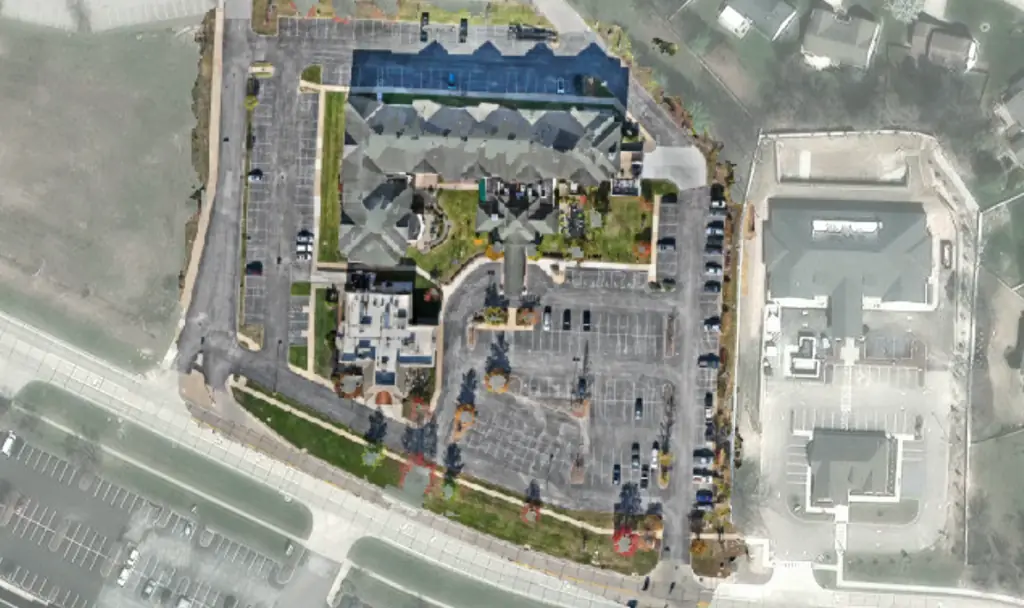
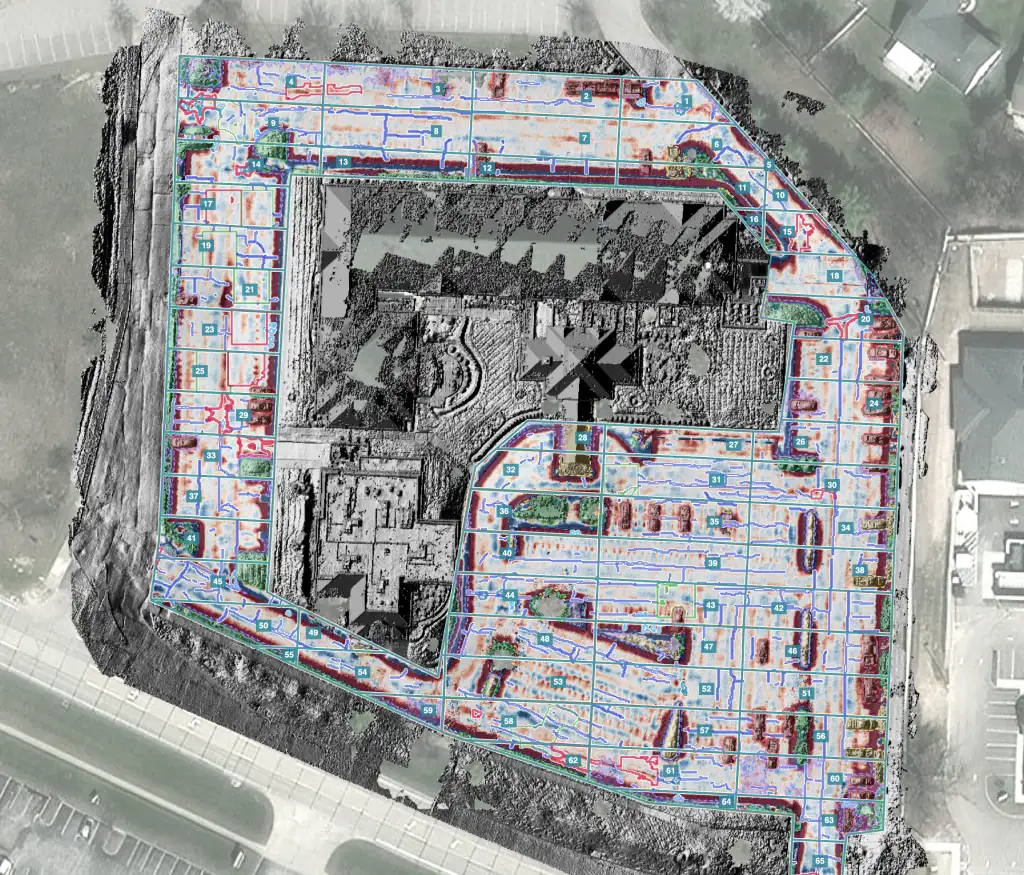
The same survey scores the pavement to ASTM D6433 and produces a maintenance and repair plan, with quantities priced at your own unit rates, so the safety findings and the repair budget come from one flight. Faded striping, crosswalk paint and the stall layout are visible in the same imagery for whoever reviews it. Drainage problems show up as standing water. Lighting still needs a night walk, and ice is only recorded if it is there on the day of the flight.
Every dataset receives a data-quality grade from A to D, and each survey is dated. Fly the lot again after repairs and the next survey adds to the site's condition history, recording the hazard as gone.
Who the record goes to
Each dated survey is the record of the site's condition on a known day, and it goes wherever that question is asked:
- The insurer, at renewal, as the record of the lot's condition and of the repairs made since the last survey.
- The claims handler and counsel, when a trip-and-fall or slip-and-fall claim arrives, as the record of what the surface looked like and when it was last surveyed.
- The paving contractor, as a measured repair scope ready to price.
- The acquisitions team, as the condition of the lot on the day the property changes hands.
At acquisition: the pavement in due diligence
A property condition assessment under ASTM E2018-24 is a visual walk-through. Parking, paving, curbs and drainage are typical site-improvement items in one, but the scope is set by the contract, and pavement is sometimes left out. A measured, dated survey at acquisition records the condition of the lot on the day you take it on, with an ASTM D6433 PCI and a repair plan priced for the capital budget. If a claim later turns on how long a hazard existed, that survey is the starting point of your record.
Start with one lot
The quickest way to see the record is on one of your own sites. Get 1 ha analyzed free and receive the scored lot, its trip-hazard map and its repair plan. The parking lot inspection page shows the full deliverable, and what is new in HALO AI covers everything the same survey measures.